

Why Stable Tool Wear Matters More Than Initial Penetration Rate
- Date:2026-02-25
- Share with:
A tool that drills faster at the beginning is frequently perceived as more efficient. However, in real field conditions, initial penetration rate is a short-term metric. What ultimately determines drilling efficiency, cost stability, and equipment protection is not how fast a tool starts — but how predictably it wears.
Performance stability is an engineering variable. And tool wear behavior defines it.
1. Initial Penetration Rate Is a Transient Indicator
The first meters drilled reflect:
lFresh cutting edges
lMaximum impact energy transfer
lIdeal geometric condition
lMinimal vibration
But this condition is temporary.
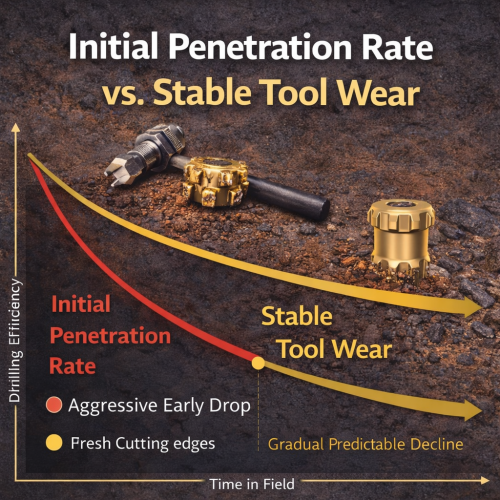
As wear begins, the penetration rate inevitably declines. The key question is not whether performance drops — it always does. The real issue is how the wear progresses.
Does the tool wear gradually and predictably?
Or does it degrade unevenly, causing sudden performance instability?
2. Wear Pattern Defines System Stability
Stable wear behavior means:
lUniform button or edge wear
lControlled gauge reduction
lConsistent energy transmission
lMinimal vibration escalation
lPredictable penetration decline
Unstable wear behavior leads to:
lSudden drop in drilling speed
lEnergy loss through deflection
lIncreased air or power consumption
lHole deviation
lAccelerated wear of hammer and rods
When wear becomes irregular, the entire drilling system becomes unstable.
3. The Hidden Cost of Chasing High Initial Speed
A tool optimized for aggressive early penetration may:
lSacrifice wear resistance
lIncrease edge brittleness
lGenerate higher vibration
lShorten stable service window
In many operations, tools with slightly lower initial penetration but stable wear curves achieve:
lMore consistent daily output
lLower energy consumption per meter
lReduced downtime
lLower total cost per meter
The difference is not visible in the first few meters — it appears over the entire drilling cycle.
4. Wear Curve vs. Speed Snapshot
From an engineering perspective, drilling performance should be evaluated as a curve, not a snapshot.
Initial penetration rate = point measurement
Wear stability = performance curve behavior
Stable curves allow:
lProduction planning accuracy
lPredictable tool replacement scheduling
lReduced operational risk
lLower system fatigue
Unstable curves introduce variability — and variability drives cost escalation.
5. Tool Wear as a Design Outcome
Wear stability is not accidental. It is influenced by:
lMaterial hardness balance
lHeat treatment precision
lCarbide quality
lGeometric design
lManufacturing tolerances
lMatching with formation type
Two tools may show similar initial speed, but their wear curves can differ significantly in field conditions.
In drilling engineering, efficiency is not defined by how fast a tool begins — but by how consistently it performs.
Stable tool wear protects:
lSystem energy efficiency
lEquipment lifespan
lHole quality
lOperational predictability
lTotal drilling cost control
Initial penetration rate is visible.
Wear stability is structural.
And structural variables always dominate long-term performance.